Professional, certified restoration services for Marin County homes and businesses.
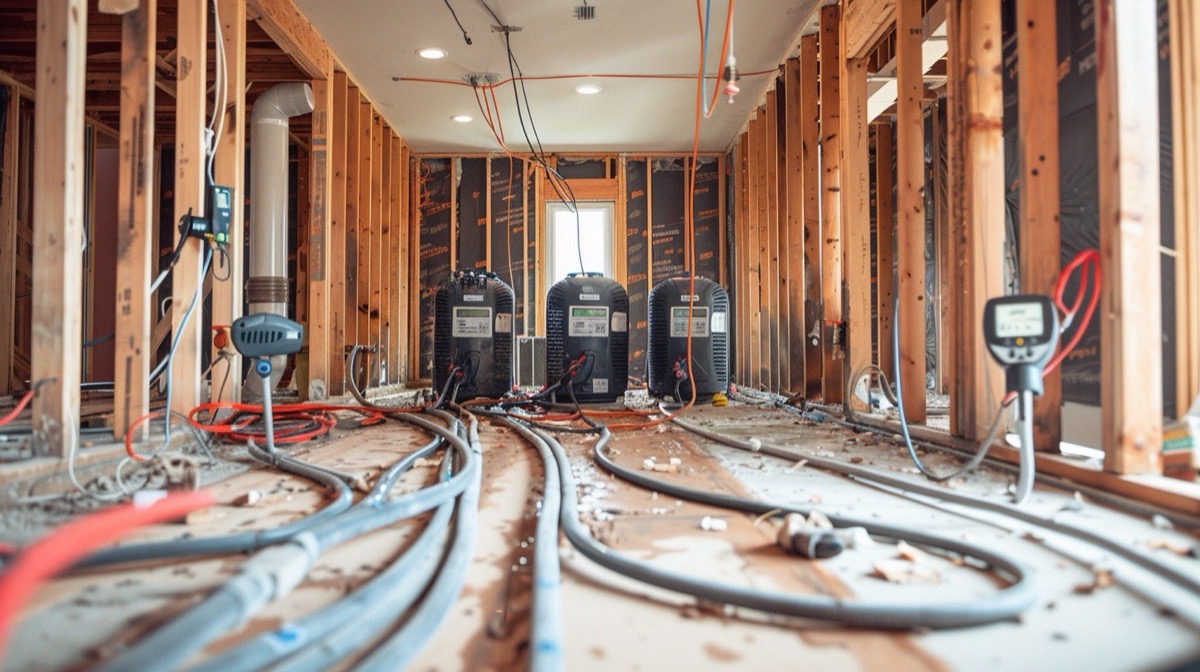
Water extraction only gets the water you can see. What's left behind gets absorbed into drywall, subfloor, wood framing, and insulation, and it doesn't just evaporate on its own before real damage sets in. We use moisture meters and sometimes thermal imaging to map exactly where water has traveled inside walls and under flooring, not just where it's visible on the surface. That mapping tells us how much drying equipment a job actually needs and where to place it. This step usually starts right after water extraction wraps up, since the two processes work best back to back rather than with a gap in between. We've dried out everything from a single bathroom in a Corte Madera condo to a full first floor after flooding in Larkspur, and the approach stays the same: measure first, then dry to the number, not to a guess.
A house can look dry and still be holding a dangerous amount of moisture inside its materials. Wood trim that's started to cup or crown, drywall that feels slightly soft or cool to the touch, or a musty smell that lingers days after the water was cleaned up are all signs that something underneath is still wet. Baseboards pulling away from the wall or paint that's starting to bubble usually mean moisture is trapped behind the surface, not just sitting on top of it. The only way to know for sure is a moisture meter reading compared against a dry standard for that specific material, which is exactly what we check before we call a job finished.
The restoration industry classifies water damage jobs by how much moisture is involved and how fast it will evaporate, not just by how the water got there. Class 1 is the easiest, minimal absorption, limited to part of a room, and it dries fast. Class 2 involves a full room or more, with moisture wicking up walls and into carpet and cushion. Class 3 is the worst of the three common classes, water coming from overhead or saturating walls, ceilings, insulation, and framing throughout the space. Class 4 covers specialty drying situations, hardwood, stone, concrete, or plaster that holds moisture deep inside the material and needs a slower, more specialized approach than standard air movers and dehumidifiers can handle. Knowing the class before we start tells us how much equipment to bring and roughly how long the job will take.
Once moisture mapping is done, we set up a combination of air movers and either low-grain refrigerant or desiccant dehumidifiers, depending on the size of the space and how much moisture needs to come out of the air. Air movers keep evaporation moving across wet surfaces, while the dehumidifier pulls that moisture out of the air before it resettles somewhere else in the house. We check moisture readings daily, not just at the start and end of the job, and we adjust equipment placement as materials dry at different rates. Left wet long enough, any of these classes can turn into a mold remediation job, which is why we push to get a property fully dry within the industry-standard window rather than declaring it done early.
Insurance adjusters want more than a general statement that a property is dry. We track daily moisture readings for every affected material, log equipment run times, and photograph the space throughout the drying process, and all of that becomes the documentation package your adjuster reviews to close out the claim. Without that kind of record, it's harder to prove the job was actually completed to industry standard rather than just until the visible water was gone. We build that file as we go, so there's nothing to reconstruct after the fact when it's time to submit.
